
Today, we got an overall talk on Zoe from Trice. She opened by talking about Joseph. I had expected her to take the tack of speaking of how Joseph was the marginalized child that nobody liked (at least, among his brothers) and how he was able to provide value to his entire family in spite of that, but instead she said WE, the donors, were the ones adding value.
Some quick excerpts from my scribbled notes follow. This will be a bit disjointed because it’s late at night and I just want to get something out without spending too much time wordsmithing it.
The Tanzania program was started in 2019. It was very hard at first to convince the government of the model because the government kept expecting a relief model, or a model of some sort of corruption. The relief model asks, “how many children will you feed?” and the corruption model asks, “are you loaning these kids money with the expectation of a return with interest?”
The answer is, “neither of those. We are expecting to build relationships with these kids, and the return on investment is that they will (likely) never be beggars or need government support again.” The empowerment model gives these kids RESPONSIBILITY. And the Zoe program gets RESULTS. As a result of that, now, when government officials visit, the Zoe program is at the top of the list of things to visit, which is quite different from how things were when they started.
The population of Arusha is 600,000 and the Tanzania Zoe program has touched almost 7,500 kids, so that’s 1% of the population of Arusha.
The program is currently balanced between urban and rural kids. The difference is that the urban kids are sharp, but also unstable in that they sometimes fly hot and need to be talked down, or something in their life changes such that they miss some group meetings.
Another difference between urban and rural is that the urban kids don’t have the available land to plant crops, but they still do plant food for themselves in tiny plots or even containers of soil.
The rural kids are mostly Maasai, and there are some cultural issues that need to be overcome there (mostly having to do with things like forced marriage), but progress IS being made.
The Zoe program is constantly being adjusted as the staff see what works and what doesn’t; it doesn’t necessarily stay in a fixed format. However, the basics are still adhered to, and those are (skip this if you already know it):
- Basic education on hygiene (in order to stay healthy, obviously);
- How to grow your own food;
- The basics of entreneuership and how to run a small business;
- What each child’s legal rights are;
- Some trade skill training (e.g., sewing, mechanics).
And finally:
- These orphans and vulnerable children are formed into a social group, so they can support each other emotionally and with advice, group decision-making, and accountability.
(Ok, stop skipping.)
The facilitators took some questions:
“What is the most surprising thing to you, as a facilitator?”
Answer: Listening to the kids is important. Right speech to the kids is important. The facilitators are worried that they’ll do damage to the kids by saying something wrong. This is very different from relief programs (which many of them are familiar with and may have worked in), because in relief programs, there’s no chance to evaluate effectiveness (other than “how many kids did you feed?”) because you give a kid relief and then you may never see that kid again. The empowerment programs are about building relationships — the facilitators know their kids and can see them grow.
The mentors (community members who volunteer to mentor the kids regularly and frequently, since the facilitators can’t be present all the time) are really important.
“Why so many orphans?”
It’s hard to say, but Trice took a stab at it.
- Poverty — parents die young;
- Polygamy — a single mother may get sick and there’s no dad to help;
- HIV — there is still some stigma around getting diagnosed, so people don’t get diagnosed in time;
- Malnutrition — as in poverty, parents die young.
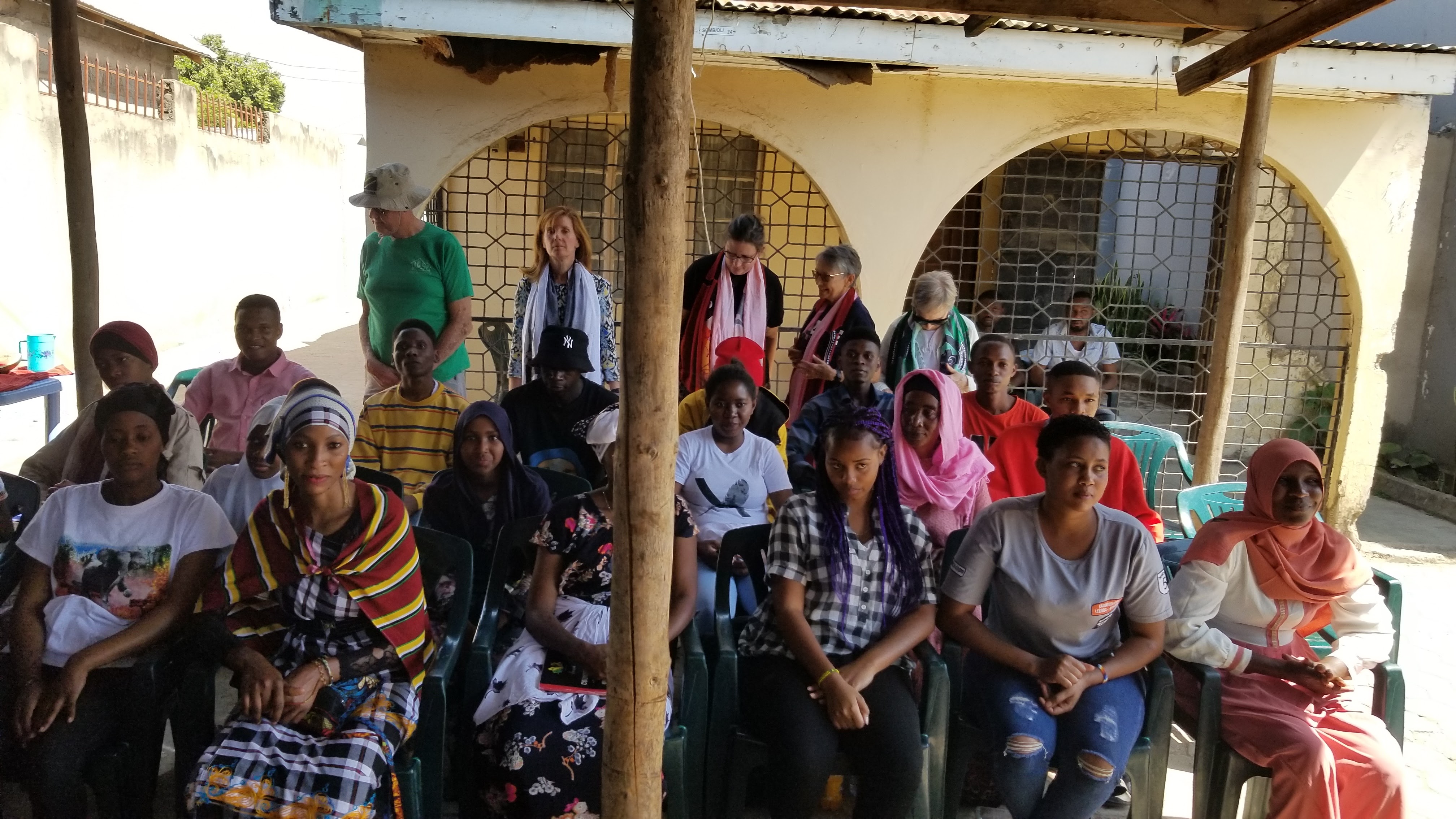
We went to visit some Zoe graduates. They are doing very well. Many of them run multiple businesses and/or have moved away from Arusha because they found better markets for their goods and services elsewhere. They have kept their siblings in school and several of them have hooked up their grandparents with running water. They have been out of the program for almost two years, so I was particularly impressed that they actually came back to present to us — it speaks to me of how important this program is to them.
We heard their report from an Islamic member of the group, and several members of the group were Islamic. I take pride in that personally because that means Zoe is open to all. It is a Christian organization and we are showing the love of Christ, but we’re not requiring anybody to convert, nor are we even pushing it. I think it is good enough that as many people as possible know that God loves them, full stop.
A quick run-down of some of the things the group did when they were still in their 3-year program: selling “chips” (fried foods like potatoes or a ground-bean-and-onion mixture, and usually extending to chicken); selling clothes; selling chicken; selling fish; selling maize, beans, and grains; selling shoes; selling jewelry (I think), selling fruit and other produce; vehicle repair.
Their achievements include: diversifying their businesses; better housing; more education; pit latrines (not sure what that’s a step up from); tailoring training; shifting to other locations to take advantage of better opportunities.
Then, about ten members of the group spoke of their individual achievements, which I won’t repeat here. Finally, their mentor spoke, and a couple of things she said were:
- These kids were loved and supported (relationships were built); and
- These kids had a “different spirit”. I believe that meant that they had a different “spirit” from other kids who were in relief programs, and this “different spirit” is a good thing.
Finally, Trice spoke again, and she spoke of the story of the ten lepers who were healed by Jesus, and only one turned back to thank him. I’ll have to think on that some more.

 UUMC ZOE Trips
Very impressive! We want to help spread this at UUMC for sure.
LikeLiked by 1 person
Wow! What a difference ZOE is making for these kids!
LikeLiked by 1 person
So encouraging that these kids are doing so well!
LikeLike