Category Archives: Uncategorized

Peace Gitura

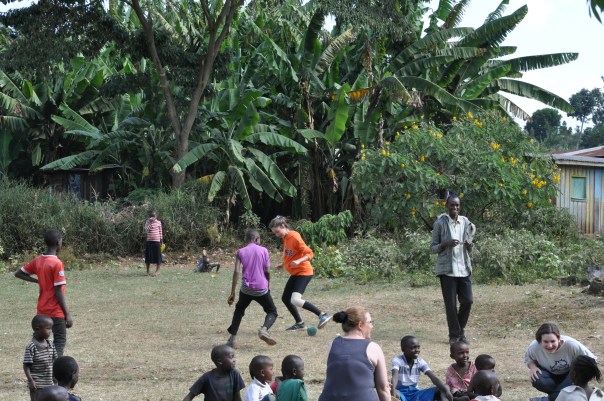
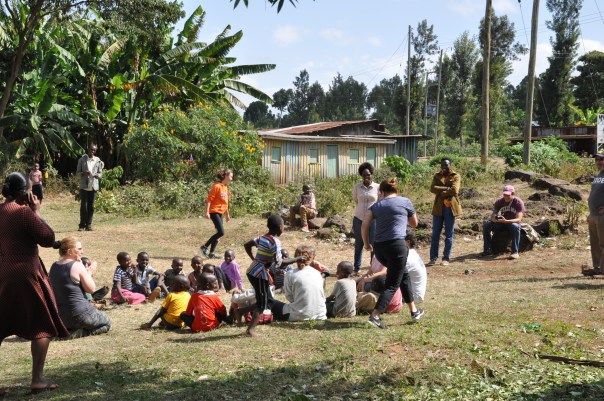
Tuesday morning, Carol, Corinne, Savannah and I went to visit University UMC’s Hope Companion Group, Peace Gitura, which formed in January, 2016. The program facilitator for the group, Agnus, and Perpetual, the communications director for ZOE Kenya went with us.

The group met at the home of Felister. They welcomed us with singing and dancing. After we sat down, the Chairman, Anthony, welcomed us. He told us how the group has learned to love each other like a family. They visit in each others homes and correct each other like brothers and sisters.

Norah is the group’s mentor. She is a beneficiary of ZOE, who trained in hairdressing and started a salon. She still runs the salon to support her family. She graduated from ZOE in 2012 and petitioned ZOE to start another group in her village. She continues to meet with some members of her five years after they graduated.

Before ZOE, Annrita worked as a casual laborer, often working as a laundress. With ZOE’s support, she started a kiosk. She saved her money and got trained in motorbike (bota bota) repair. She started selling spare parts and now also does repairs. She also has her own bota bota which she runs as a taxi. When she’s busy, her brother runs the taxi. With all she’s gained through ZOE, she’s been able to take another orphan into her family (he’s 12-13) and is teaching him bota bota repair skills as well.

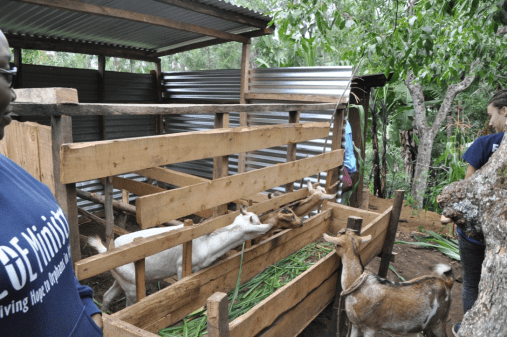
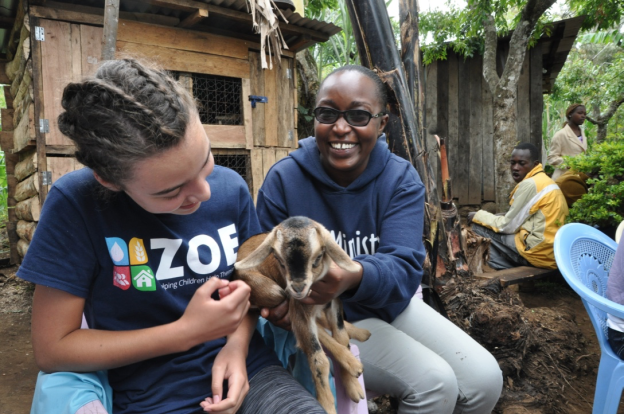
Felister used to go around the community looking for work so she could eat. Her older brother inherited a house and land when their parents died, but the house was small and in disrepair. They were unable to effectively farm the land because they didn’t have tools or knowledge. In addition to her older brother, their elderly grandmother lives with them. Since joining ZOE, they have been able to build a new house. They have lots of chickens, three grown goats and a 2 week old baby goat who was quite interested in us. She earned a hoe and a machete which helps the family in their farming activities. Through ZOE’s health and hygiene training, Felister learned about keeping herself and the areas for her animals clean. She also learned about brushing her teeth after every meal and cleaning her food and utensils. The family build a hand washing station next to their latrine, so they always wash their hands after using the toilet. There was recently an outbreak of cholera in the community, but thanks to their training, the ZOE kids didn’t get sick. Her older brother is thankful for ZOE and what his family has received through his sister joining the group.
One of the girls, Penina, told about her friend Britney who was in the group. She had finished the 8th grade, but was unable to go to high school. She asked for assistance and the group decided that because she had done so well in school, it was important for her to continue her education, so the group supports her going to high school. The group members also contribute 50KS per month to assist her grandmother while Britney is in boarding school. She is now in 10th grade and is doing well.

Glory learned about farming and food security from ZOE and was supported with planting seeds. The crop did well and she had some to eat and some to sell. She was able to buy more seeds to expand her business and also owns a kiosk. Her family is doing well with all their needs.

Elizabeth has one younger sibling. They shared a very small house and didn’t have a bed. ZOE helped her get a bed and a nicer house so she sleeps well at night and doesn’t get rained on.

Floridah serves as the group pastor. She was a casual laborer on farms before ZOE, but she wouldn’t always get paid, so she would sleep hungry. She now runs a kiosk and has started a hair salon with her savings. The group provided her with tailoring training and supported her with a sewing machine. She used to think that if you didn’t have parents you would always have to work for others, but now she works for herself. She is supporting her sister in 10th grade, as well as a younger sibling and her young child, and is also a mentor to other orphans in her village. She teaches them tailoring and dressmaking and allows them to use her sewing machine. She thanks God everyday because she sees how far she’s come. Annrita is also teaching her to ride a bota bota. She wants to start a 4th business as a mechanic.

Anthony, chairman of the group, now owns a barber shop. Before ZOE, he would work feeding animals for food and sometimes shelter. It made him feel so bad and he had low self-esteem. He often had nowhere to sleep. Now Anthony works for himself and has built a house for himself and his two siblings with money he’s saved from his work. Now they live better than some people who have parents and some who used to give him jobs.

Emmaculate was adopted into the group after it formed. She started a porridge business. She usually wakes up in the morning, makes the porridge and moves around the village selling the porridge r from jerry cans. She has 5 younger siblings and a one year old child. They all live with her grandmother. Through the group she received hairdressing training and has started a salon. She plans to teach her siblings hairdressing. She loves farming, so she grows corn and beans.

Floridah gave the secretary’s report. The group formed 1/15/16 with 32 members. There are now 28. Four members were initially supported with startup kits, two salons and two barber shops. Three members were sent for training and then supported with startup kits. All kids were taught in food security and were given maize and beans to plant.

The ZOE staff helped the group build a house for one of the members in need. The group projects are a garden where they grow maize and beans and raising pigs. They started with 5 piglets but 2 died. The first harvest wasn’t good because there wasn’t enough rain, but this harvest looks like it will be better. They have a group Merry-Go-Round fund. When the group first formed, they gave 50 KS each per week and bought utensils for each member. Now each member contributes 100 KS per week. They also give 30 KS for the member who cooks the porridge that week. All the money then goes to that member to boost his or her business. The group also has a Table Bank, which is up to 8600 KS. All the money is out with members as loans for business improvements. In three years they want to be running their own micro loan business in the village.

The group agrees that Felister, Floridah and Annrita are tied for first in the group in terms of how well they are doing.

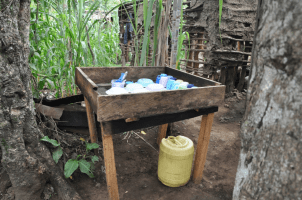
After the group report, we shared a snack of millet porridge, watermelon, a very sour fruit that’s a cross between an orange and a lemon, and milk tea. The boys were mostly quiet, but the girls asked lots of questions so we had a great time of conversation. After the meal, the meeting broke up and we had the chance to admire Felista’s home. They have several buildings, a nice chicken house and goat enclosure, a clean, well built latrine, and several crops that are thriving. We also saw their compost pit, their hand washing station and their dish drying rack, all health and hygiene “homework” projects they did to earn their hoe and machete.
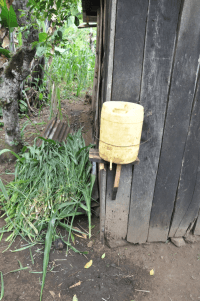
We then went into the village and visited three businesses. First we visited Felister’s hair salon.
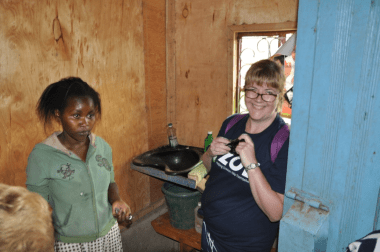
Then we saw Anthony’s barber shop, where he also sells drinks and serves tea and coffee for the young men who come to watch the news on his TV in the evenings.
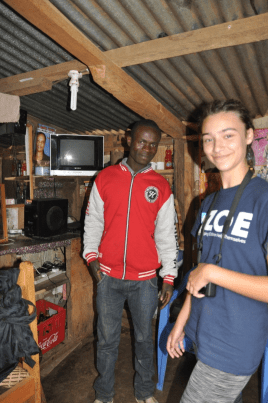
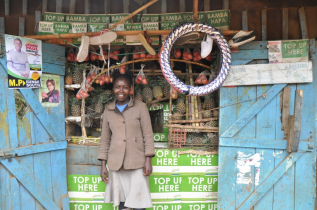
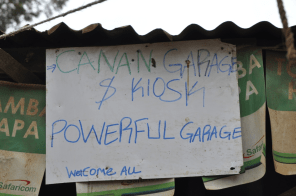
Finally we visited Annrita’s bota bota repair shop and kiosk.
Sunday in Maua

Today was another busy day.  This morning we attended the Kiswahili service at the Kenya Methodist Church in Maua.  The service started at 10 and ended about 12:20, but there was lots of dancing and singing, so the time passed quickly.  Although we couldn’t always understand what was being said, the Lord’s prayer and the creed were recognizable.  They also switched back and forth between English and Kiswahili, and projected slides in English so we weren’t always in the dark.

After the service the Chairman and Deputy Chairman invited us for tea and conversation where they thanked us for visiting their church.

When we returned to our hotel, we ate lunch out in the garden and then had a chance to shop with ZOE graduate seamstresses.  Afterwards we heard stories from other ZOE graduates:

Doreen has three siblings.  She has a hair salon and with profits from the salon, she bought goats.  She has now expanded her business to three employees and sells braids in her shop.  She has trained five ZOE children and countless others in her community.  She chose hair styling as a business because she had a passion for the work and there was a good market in her community.  Her vision is to work hard and to help her sister, who is currently in 6th grade through high school.

John (25) takes care of six siblings.  Before ZOE he worked on Mira farms to earn money to feed his family.  In ZOE he was trained in barbering.  From his profits, he added selling paraffin to to his business.  Now his family eats a balanced diet and all of his siblings are in school.  One is in 9th grade.  When he graduates from high school, John will organize a fundraiser for him to go to college.  When he has trouble with his siblings, he calls the mentor from his group who talks to them because she is still his “mother.”  He now is employed as a Coca Cola distributor. He has also been able to return to school and is now in his last semester of college majoring in community development and social work. His vision is to work for an NGO or the government. His group’s project is a maize farm and plantain and they still work the farm together. The crop was not good this year because of lack of rain.  With his profits he wants to buy another piece of land. His house was too small for his family so he has built a larger, more comfortable house.  He speaks English well.

Agnes (25) had many problems before ZOE. She worked as a housemaid for several homes for $15 a month but sometimes wasn’t paid. When she joined ZOE, she opened a salon. She has sent her siblings back to school. They are 10, 14 and 18. She bought a cow.  She works alone because her salon is in her village, so there’s not enough business to expand. When she can open a salon in the shopping area of town, she will have more customers.  For now, she plans to open a kiosk next to her salon to expand her business.

Jackson (18) has five siblings. Before ZOE every day he would walk around the village looking for casual labor.  With ZOE he began raising goats. With the profits from selling the goats, he bought chickens and then rabbits. Now he raises all three to sell. He has sent his siblings back to school, and he has returned to school as well and is now in the 11th grade.  He says that ZOE has allowed him to dream again and that his program facilitators, Purity and Agnes, have inspired him.  Before he had to go to a neighbor’s house to study. Now he has a nice house where he and his siblings can study. And they have a latrine. He plans to go to college. His dream is to be a bridge between the community and development opportunities. He also wants to mentor to children in his village.

Doris (21) has three siblings in seventh and ninth grades. She is a seamstress and makes $3 on a good day and $0.50 on a slow day.  She would like to open a second store and employ others.

Martin (26) has three siblings. One finished 8th grade. And two are in primary school. Before ZOE he worked on others’ farms and digging. Now he is a barber and doing well. Additionally he has a phone charging and battery charging center.  He wants to expand his businesses. He has trained community people in barbering but has not yet had an  opportunity to train ZOE kids. He has bought four goats and one cow. He had to drop out of school in the fifth grade so he doesn’t speak English but does understand some.

Followup Trip 2017

So here we are, two years later.  Unfortunately John could not come on this trip, so I have to take up the blogging stick.

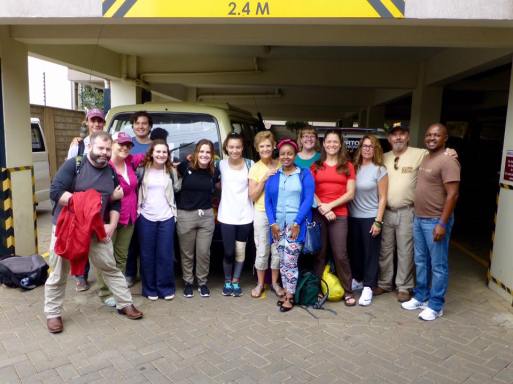
Savannah and I left from Raleigh on June 28th, after a bit of panic at the ticket counter when her reservation couldn’t be found.  In London, we met up with more of our team, including my mom (Carol)  and Corrine, my long time friend and Savannah’s godmother.   Another 8 hour flight on Thursday and we were in Kenya.

We were met at the airport by Reegan, ZOE’s Chief Program Officer and Kenya Country Director, and Perpetual, ZOE’s Communication’s Director in Kenya.  By the time we got to our hotel and got our rooms it was after midnight.  A few of us had a quick snack and then headed to bed.

19554191_10213596779217318_938903420661070488_n

On Friday, our whole group of 12 loaded up into two vans for the trip from Nairobi to Maua.  It was a long journey, but it gave us some time to get acquainted and to see some of the country.  For lunch we stopped at Trout Tree, a fun restaurant that is basically a big, open treehouse with trout ponds.  They also have several families of Colobus monkeys who hang around and will steal food off your table if you’re not careful.

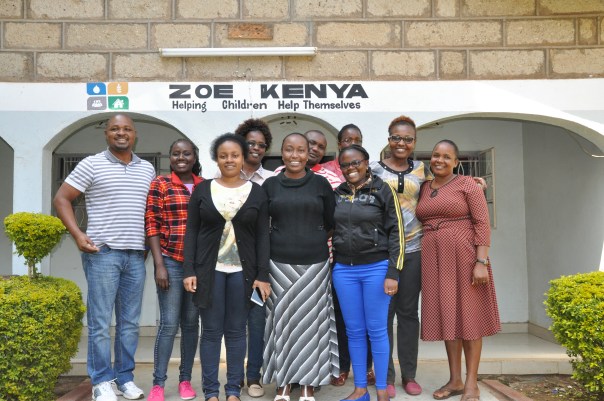
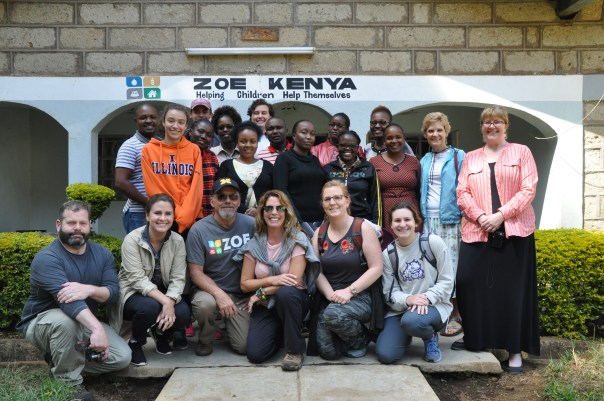
This morning (Saturday) we started off at the ZOE offices, meeting the program facilitators and learning more about how ZOE works in Kenya.  The program facilitators are the staff members who guide the working groups through formation and are a support through their three years in the program.  From the very beginning, though, ZOE prepares the children to exit the program in three years.  Therefore the program facilitators are only there to guide and advise and they do most of that in the first year, giving the children more and more autonomy over time.  Each facilitator provides support to  9-11 working groups.  Each working group is made up of 25-30 heads of household, representing 70-100 children when siblings are included.  Here we are with the staff outside the ZOE offices.

56

After our visit to the office we went on to meet a ZOE graduates working group.  This group formed in 2012 and graduated in 2014.  They still meet weekly as a group, although some of their members have moved away for jobs or to get married.

After some singing and dancing, the Chairman of the group, Moses, started us out with a prayer and the story of Tobias.  He reminded us that whatever we want from God, persist in asking and God will come to you.  God has the answers to all the challenges we face.

7

Then some of the group members shared their testimonies with us.

Moses is a carpenter and has his own farm and bota bota (motorbike).  He has built 5 houses for other children in the program and is committed to training 5 children in carpentry as a way to payback what was given to him through ZOE.  He has two siblings.  One drives Moses’ bota bota as a taxi.  Moses is paying for the other to do driver training.

When Micheck’s father died, he and his sibling were left with their mother and no house.  He started a shop with the initial money he received from the group.  With money he earned from his shop, he was able to build a shelter for his family.  Then he was able to purchase land and plant banana trees.  Then he was able to purchase a bota bota, which allows him to ferry stock from wholesalers to his shop.   He also allows other people to hire it when they need transportation.

Irene told us how when they joined ZOE, they were taught health and hygiene, how to have good food and how to keep their house clean.  Before ZOE, she and her 7 siblings didn’t have blankets or a good house and didn’t wear shoes.  They had all dropped out of school.  Now she sells eggs and porridge and has goats and chickens.  She has sent her siblings back to school and has built a house for her family.

Joseph is the group secretary.  He supports his 6 siblings and his mom.  He trained as a barber and also uses his barber shop as a place to sell tea in the evenings and to charge phones.  He trains other ZOE members for free.  He has plans to extend his shop for a salon.  Through the money he earns, he is sending two of his siblings to school (9th and 11th grade) and is prepared to help them go to university.

Allison and her three siblings had no one to support them.  They had no say in their community, but their life and family have been changed by ZOE.  Her siblings are back in school (1st, 5th and 7th grades), she has opened a small, clean restaurant, and she has bought chickens and goats.  She is now a part of her community.

Martin is a farmer and an entrepreneur.  He learned farming in his first month in ZOE and was given planting seed which he was able to turn into a harvest of 100kg of beans.  He used the proceeds to feed his family and with what was left he started a nursery to raise collard green seedlings.  He sold the seedlings for $150 and was able to buy a digital camera, which he used to take pictures of people.  He invested the money he earned selling photos into his nursery business and at the next harvest earned enough money to buy a laptop which he used to process his photos.  By his third harvest, he bought a printer so he could print the photos himself.  He is now a photographer and videographer for ceremonies.  With the money he’s earned, he was able to buy and plant more land, to build a large house for his family and to put his three siblings through school.  He is now saving to buy a bota bota to carry his crops from his farm to his store.  Martin also serves as the pastor and spiritual advisor of the group.

Finally, Sabina, the group’s mentor shared with us.  She told us how little these kids had when she met them and how proud she is of all they’ve accomplished.  They are like her own children, and you could see her joy in them.

After this time of sharing, the group fed us a lunch of millet porridge, baked sweet potatoes and bananas.  Afterwards, some of the group played soccer with kids from the area, while others taught a group of kids how to play duck, duck, goose.

98

On our way back to Maua and our hotel, we stopped and visited Joseph’s barber shop and Micheck’s store.  No one was up for a shave, but we did buy cocoa and tea from Micheck.

It was a full, but rewarding day.

Tomorrow we will go to the St. Joseph’s Kenya Methodist Church and then meet more graduates in the afternoon.

Peace & Unity,

Erika

Trip Blog Posts in Chronological Order

I have now posted all of our “trip blog posts”, in semi-random order. (I still need to post videos, but it’s taking way too long to get back to those.)

Here they are, strung together in chronological order:

Nairobi

Travel to Maua

Day One: Our Working Group

Day Two: Church

Day Three: Tharaka and the Third-Year Group

Day Four: The First-Year Group

End: Safari

A Connection Made in Church

So, here’s the tiny (microscopic) story of our money-changing “adventure”.

(I’ll just put the pro tip here: when you exchange money for Kenyan shillings at the airport in Nairobi, don’t assume you can always exchange more later. You can, but it’s a pretty big inconvenience. Go ahead and get all you’ll think you’ll need plus a little more at the airport.)

On the day we visited the first-year group, three of us realized we hadn’t taken into account the gratuities we’d be paying our drivers and hotel staff, and our plans for some end-of-the-trip shopping. So, we had to cut our visit with the working group short (which I think is sad, actually) and hightail it back to Maua in time to get into a bank (Barclays) by 4:00 pm. We just barely made it.

Once in, we got in line to wait for a teller. (While we were in line, I saw a poster advertising Barclays’s new low interest rate for home loans: 10%.) When we got to a teller, we asked to exchange $20 for Kenyan schillings.

Well. First they asked us for our passports. Then, it seemed like they didn’t exactly know what to do next (although they didn’t say that). So, they asked us to have a seat and wait. We did. And waited. And waited. And waited.

Meanwhile, the bank was closing.

At one point, a man walked over to us and said “I think I can say hello.” He was very friendly. It turns out that he was in church when we stood in front and introduced ourselves. So, he was literally just saying hello. It was very pleasant.

Eventually, we got our Kenyan shillings and our passports back, although the rest of our group, waiting back in the van, had begun to worry about us.

Used T-Shirts in Kenya (Planet Money Podcast)

Planet Money, an economics podcast by NPR, had a really interesting episode on what happens to used T-shirts. It turns out some of them wind up in Kenya and (I’m assuming) worn by the kids in our working group. And, every step of the way (of course), they generate economic activity.

The first stop in Kenya is at the business of a woman who, 15 years ago, was selling used T-shirts one at a time. I don’t know for sure, but I’m imagining a kiosk like the ones our kids run.

Here’s the episode: The Afterlife of a T-shirt.

Reegan’s Long Backgrounder Lecture the First Day

So, the morning after we arrived, before our first visit (to our working groups), Reegan sat us all down in the patio area of the hotel and gave us a long background talk on ZOE, very dense with figures and procedures. It took at least 90 minutes. Here is as much of that as we could capture.

(This turned out to be a monstrous post that took a while to reconstruct from the excellent notes Erika took, with a few of my own sprinkled in. This applies to ZOE in Kenya, as told to us by Reegan and fleshed out with my own impressions and recollections, as hazy as they are.)

Continue reading Reegan’s Long Backgrounder Lecture the First Day

Kenyans use cell phones for everything from buying groceries to paying rent – World News

On cell phones in Kenya. We noticed that more people than we expected have a cell phone in Kenya, including some of the orphans. It turns out that having a cell phone in Kenya is actually pretty cheap,  in addition to being useful for business and for just plain human connection.

http://worldnews.nbcnews.com/_news/2012/07/24/12909129-kenyans-use-cell-phones-for-everything-from-buying-groceries-to-paying-rent

Here’s an article on cell phones and the “law of one price:”  http://www.economist.com/node/9149142

The upshot is: we shouldn’t make assumptions that what we pay for cell phone coverage in the U.S. is what the rest of the world pays.

The Rest of Our First-Year Group Visit

After the group did their presentations, and we each spoke, Reegan spoke.  He had strong “you can do it” encouragement for them (hopefully, I got it on video, but if not: it was powerful).  He knows what the orphans face, and he knows they are capable of overcoming it.  I hope to hear from this group (“Barakuro Glory”) to see if they get crops next year, because that landscape looks almost Martian.
Continue reading The Rest of Our First-Year Group Visit