Monthly Archives: September 2026

Monday, September 14

Today, we went to visit our UUMC group, Comfort Mafararawika, along with two other groups, Visionaries and Kwadzana, all second-year groups.

After about a 90-minute drive in a van with rather hard seats, we arrived the town of Mafararawikwa, to the southwest of Mutare.

Where we pulled off the road into sort of a dirt track leading into a field, the groups lined both sides of the track, and we drove in between them. They were holding signs with our names on them, the names of the churches we were associated with (in this case, it was just UUMC) and singing. It was quite the welcome. We gathered under this baobab tree (I had to zoom out to less than 1x zoom to capture it), which Google thinks is 300-600 years old:

Here are some videos of our welcome:

Each group had some rousing group cheers, which we didn’t capture, but all three groups together had one, which went like this:

We are connected!
We are safe!
We have hope!

I think at this point, we were presented with gifts from the groups. Erika and I were each gifted an article clothing (shirt for me, dress for Erika), and then we were gifted an enormous banner saying “Thank you, University UMC”, along with a doormat saying “UMC”. We’ll have to find a way to show the congregation what the kids have made for us.

Then we heard stories from the kids. (A note on names: we’re doing our best to transcribe them, but we have probably missed some.)

Another note: you may notice a certain sameness to the kids’ stories. That reflects the experience of extreme poverty in Africa (or, at least, the 11 or so countries in which Zoe is active). They get a write-up, even though it can be repetitive, because (a) we flew 28 hours to see our partners, and (b) they’ve waiting two years to tell us their stories.

Engrace, Visionaries

Before Zoe, she slept in a house (inherited from her parents when they passed) with no doors, windows, or floor. Five siblings shared one blanket, which was not sufficient.  She had to drop out of school before she learned more than her vowels, a e i o u.

Her siblings school uniforms were faded, which was a particularly painful memory for her. Everybody had to beg for food. She did fieldwork day jobs, and was paid one cup of millet and a half-cup of salt, which had to serve as her family’s supper that night. No other seasonings. They would cook porridge just to go to sleep with something in their stomachs.

Everybody in her family wore torn clothes and did field labor, and were looked down upon by everybody else in the community.

After she enrolled in Zoe and took the basic training, Zoe gave her seed and fertilizer. She planted them and had a good harvest, which allowed her family to have enough to eat for the first time.

Zoe taught her business skills, including an important one which the salespeople among us will recognize: smile at the customers.

Her first small business was buying and reselling clothes.

Next, she got basic vocational training from a local master craftsperson in what they call “catering”. I think that is cooking and selling food. We visited her stand later, and she cooks french fries and deep-fried hot dogs, and you can buy a little box of them and flavor them yourself. (I chose spicy salt and vinegar, but I was a little too light on the spice. Next time. :) )

With the profits from the surplus of her household garden and her two small businesses, she was able to repair her house and buy new blankets. Now her siblings have school uniforms which are not faded.

Engrace expressed her gratitude for our support and hoped that we would continue to support other kids.

Dios and Abigail

Then we heard two poems. I’m afraid neither Erika nor myself took good notes on their poems, but they were a presentation of their experiences before and after Zoe.

I do remember thinking they reminded me a little bit of beat poetry or rap.

Alex, from the Visionaries group then led a group cheer.

Dream Charts

After that, we had dream chart presentations.

A dream chart is a poster each child makes when they first join Zoe. It has five sections, the first four of which contain only images:

  1. Things that make them sad.
  2. Things that make them happy.
  3. Things they don’t like.
  4. Their dreams, their hopes for the future.
  5. Guidelines for accomplishing those dreams (i.e., the important things they need to do to achieve those dreams).

Several children presented dream charts. The “things that make me sad” section had things like the death of a parent (represented by a coffin) and a visit to a hospital by a younger siblings. (Medical care in Zimbabwe has severe challenges and is very expensive if it’s available at all.) Snakes and the consequences of snake bites also showed up in more than one dream chart.

Their “what makes me happy” sections had things like church and playing ball.

Their “what I don’t like” sections had things like fighting, child pregnancy (and how that comes about is not pretty, obviously), smoking and substance abuse (usually represented by a bottle of alcohol).

The “dreams” section had things like a functioning latrine, a repaired house, new clothes, a water well nearby.

And the “guidelines” section had things like “hard work” and “discipline”.

Unified Group Report by Sharmain, Secretary of Kwadzana Group

Sharmain went over the composition of each group. They each had 27 families (don’t trust my notes here, but two of the working groups, at least, had 27 families).

Most of them lived on one meal per day or they simply slept hungry. They had no clothes other than the ones they wore, and blankets were insufficient. (My notes say “none”, but I don’t think that’s right.) They all had to drop out of school to care for their families. Many of them had no house in good repair, no dishware, no chairs or furniture, and no friends in the community.

In March of 2024, they joined Zoe and drew their dream charts.

Many of them lived on wild vegetables, but they received one 50-kilogram bag of maize seeds and a smaller bag of sorghum seeds. They also received fertilizer and insecticide. After they planted them, they were able to harvest seven 50-kg bags of seed, for a 7x yield.

(Their training had in conservation farming, which is a technique in which you dig a hole for each plant, put the seeds in and throw in some manure (excuse me, “organic fertilizer”), and then you dig another hole a specific distance away. All this is in lieu of plowing a furrow.)

In addition to their individual household nutrition gardens, they also planted a single garden for the entire working group (each of them, so three community gardens, I think).

Among the three groups of 3 x 27 = 81 households, 51 houses were given $150 in initial grants to start small businesses. These are mostly reselling goods (clothing, shoes, plastic ware, groceries) at a profit, so the seed money is to buy initial inventory.  Some of them are for more extensive farming and selling the harvest for profit (as opposed to simply consuming it for nutrition, which the household and community gardens are already supplying). Some of them are supplying services such as phone charging.

All of the members now have multiple businesses.

Hazel, Secretary of Visionaries Group

Hazel added that 30 members have received vocational training (e.g., in welding, carpentry, construction, tailoring, “catering” (food prep), barbering, etc.). After vocational training, the kids get grants of $250 with which to buy vocation starting kits (e.g., welding equipment, carpentry equipment, sewing machines, barbering and/or beauty supplies, etc.) and maybe initial supplies. How they spend the money is up to them. Since this is an empowerment model, they get to choose how to spend it (although there is guidance available).

In addition to the 30 above, 18 additional members used their own profits to get vocational training.

7 welders have been trained and are now engaged in those occupations.

She noted that, now, the larger community sees them as role models for their own children, and they buy from them.

Here are some stats she cited:

  • 10 new houses built
  • 43 houses repaired
  • 21 new toilets built
  • 21 toilets repaired
  • 11 wells dug
  • 2 plots of land purchased

Many households have bought solar panels and basic household items (such as dishes) they did not have previously.

Hazel mentioned that they now have confidence, they participate in church and community activity (whereas previously they felt ashamed of their (literally) raggedy clothes, and were ostracized), they are moving toward economic independence, and they hire other people and start businesses for their siblings to run.

Savana’s Testimony

Savana is the chairperson of the Comfort group (UUMC’s group). Her testimony follows.

Her mother died when she was 10. Her father died of COVID-19. She is the eldest of four siblings. She was deserted by her relatives. She worked in the fields, fencing other people’s gardens with thorn bushes, without gloves. She was not paid enough (i.e., not a fair wage). She felt pain, both from the thorns and from not being paid enough. She (and her siblings) ate once a day or not at all. One of her siblings got sick but they couldn’t afford medication.

Acacia thorns. Good for fencing.

She said of her Zoe enrollment that “We were not just sold dreams, but we were given the skills to achieve them.”

She is now known as a good farmer, and she is doing catering.

She said our support is going a long way, and that they pray that other vulnerable children will feel the same support.

Somewhere in here, we were presented with a gift to UUMC from all three groups, and they put on a display of some of their traditional dance. (They also presented Erika and myself with gifts for ourselves — a shirt and a dress.)

Hmm, stupid WordPress won’t let me upload a video w/out upgrading to Premium. Let’s see if I can embed a YouTube video.

Visits to Places of Business

Obvious has been trained in welding. He sells windows (metal frames ready for standard-sized glass panes) at $20 each, for a profit of $9 each. He also repairs solar panel holders and some two-wheeled carts (referred to as “Scotch carts”, for some reason).

Savana (who we met before) runs a “catering” stand. Basically, it’s a food stand outside of a larger store. We had some of her French fries (which, for those of you who don’t know, is a potato-based snack made by slicing potatoes into strips and frying them in oil — why do we always attach exotic names to things like “French fries” and “Scotch carts”?). She has actually gone back to school, so during school, she sells near the school and during school breaks, she sells at her current location.

Rockford learned carpentry, and then partnered with his friend Lazarus, who is actually not a Zoe kid. But he wanted to partner with him, so this is an example of Zoe having a wider effect throughout the community.

By the way, we found out that Zoe does actually have a wider effect on the communities in which they operate. One way is that it has a tendency to cause all community members to re-evaluate how they view and behave toward orphans and vulnerable children in poverty.

Zimbabwe, Saturday, September 12, 2026

We’ve been in Zimbabwe for a couple of days now, and, unsurprisingly, it’s been a whirlwind.

After a 7 am Sept 9 Chapel Hill — 4:30 pm Sept 10 Harare (which is six hours ahead of Chapel Hill, so equivalent to 10:30 am) = 24 + 3.5 = 27.5-hour trip, we arrived at the front entrance of the Robert Mugabe International Airport, where we met Barbara Matsanga and her senior social worker, Dennis, for three more hours of travel to Mutare, Zimbabwe’s third largest city. Mutare  is to the far east of Zimbabwe, about 8 kilometers from the border with Mozambique, in a mountainous region.

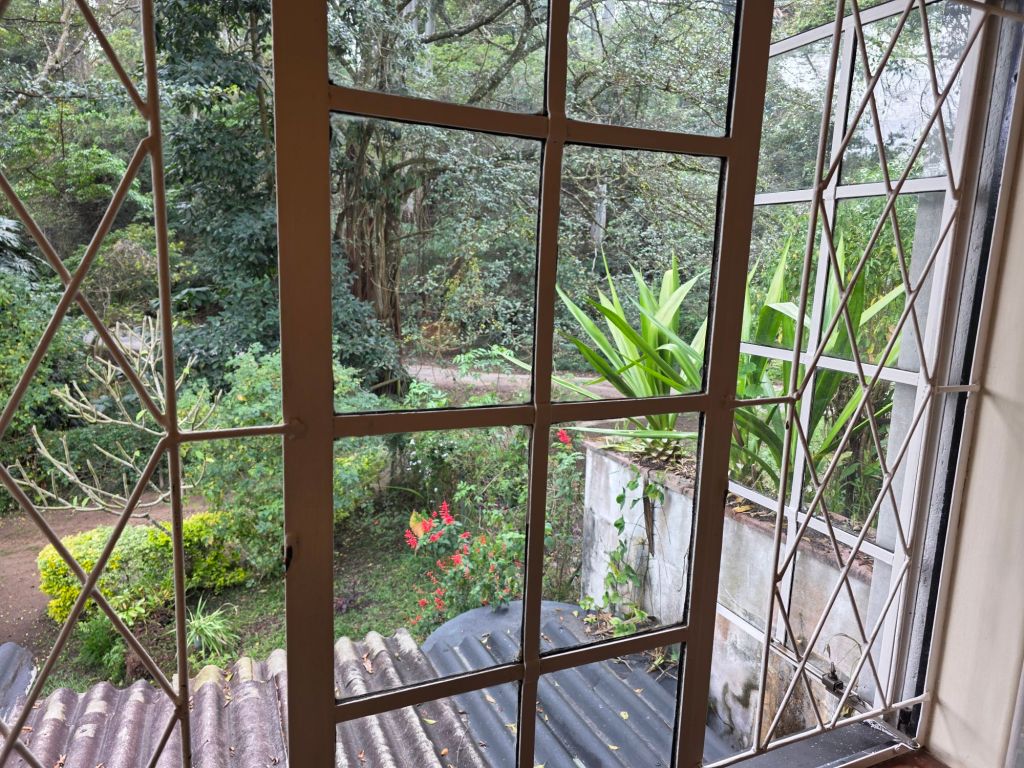
We are staying in the White Horse Inn, which feels like it was built when Zimbabwe was known as Rhodesia (I don’t know if it actually was). It’s a beautiful place nestled lush in forest, just off a curvy mountain road.

This is the view out of our room in the morning:
The first day, we met with some government officials:

  • Secretary for Provincial Affairs and Devolution
  • District Development Coordinator for Mutare & Mutasa

This was a little bit different from our experience in other countries.

Then we went to the Zoe offices in Mutare for another brief and overview.

Mona Lisa

After that, on to meet our first Zoe orphan, Mona Lisa, at her home. She actually graduated from the program a year ago. She is 24, and lives with her sister, aged 25, and two younger siblings [significant correction: at first I had written that they were her children], which I think are 7 and 12 (I didn’t take good notes because my brain was still mush).

Her sister actually got married and moved out, but there was some trouble, and she wound up moving back. She told us her story.

Before she enrolled in the Zoe program, she lived with four other siblings. Her strongest memory was that the blanket they all slept under was not enough to keep them warm in the winter. (Temperatures go down to the high 40s in winter here.) They ate one meal per day. She was unable to afford a uniform for school, or food for lunch, or even shoes, so she showed up every day essentially inadequately prepared for school. She was  looked down upon and constantly got sent home because she didn’t have the uniform, plus her siblings were starving. So, she decided to drop out of school.

Once a child drops out of school, it is a particular challenge for them to go back, because it takes them years, and then they find themselves in a class with 9-year-old, and it’s just difficult to resume.

After she enrolled in Zoe, she learned how to plant a household garden for nutrition. Part of her initial grant of $150 allowed her to buy a sewing machine. On her own initiative, she joined the tailoring training offered to another Zoe group.

She also used money she earned from table banking to buy water piping for her household garden, to make it more productive.

Table banking is an informal system of banking formed among the members of the working group, in which records are kept and money is loaned and repaid with interest. (The community at large also has table banking.) This enables Zoe kids to both borrow money for investments like improvements to their small businesses, and to earn money from interest.

She raises chickens for meat, to sell. (That was probably an early income stream.)

She also observed another woman, a member of the larger community, making woven handbags, and asked that woman to teach her to do that, which she did.

At this point, she has several income streams from these activities, which she was able to start after training from Zoe. From these income streams, she was able to send her younger siblings back to school. Education is particularly important to Zimbabweans, although sending the younger siblings back to school is a common pattern among all the Zoe orphans I’ve met.

(A note on Zoe training: some of it is offered by Zoe staff themselves, but a lot of it is contracted by Zoe with local sources. For example, a master builder or the equivalent of a local agricultural extension agent. Our money goes to things like this, in addition to paying the Zoe staff themselves, and micro-grants to the kids. I’ll have to get the ratio of Zoe staff to kids, but it’s high, something like ten working groups for each staff member (each working group will have approximately 100 total children, so that works out to a ratio of 1:1000+.)

Anyway, here’s Mona Lisa and Dennis, along with Michelle, another member of our group. (Sorry, Michelle, I don’t have better a picture of you. :) ) This is in Mona Lisa’s round hut, and these are handbags she weaves.
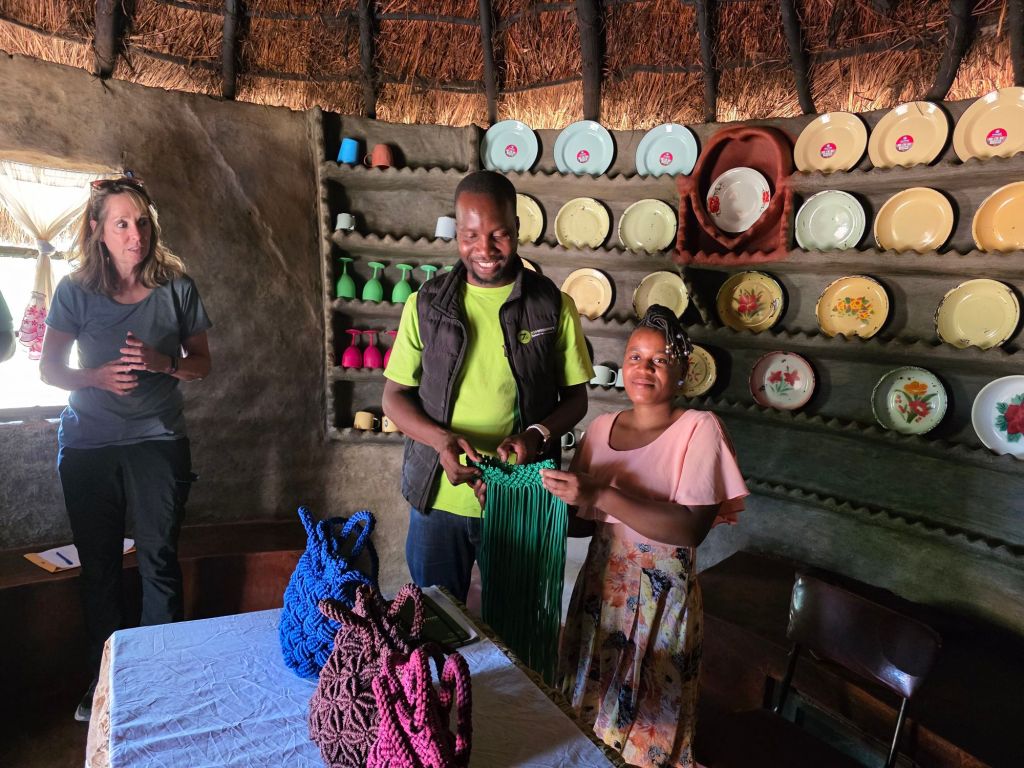
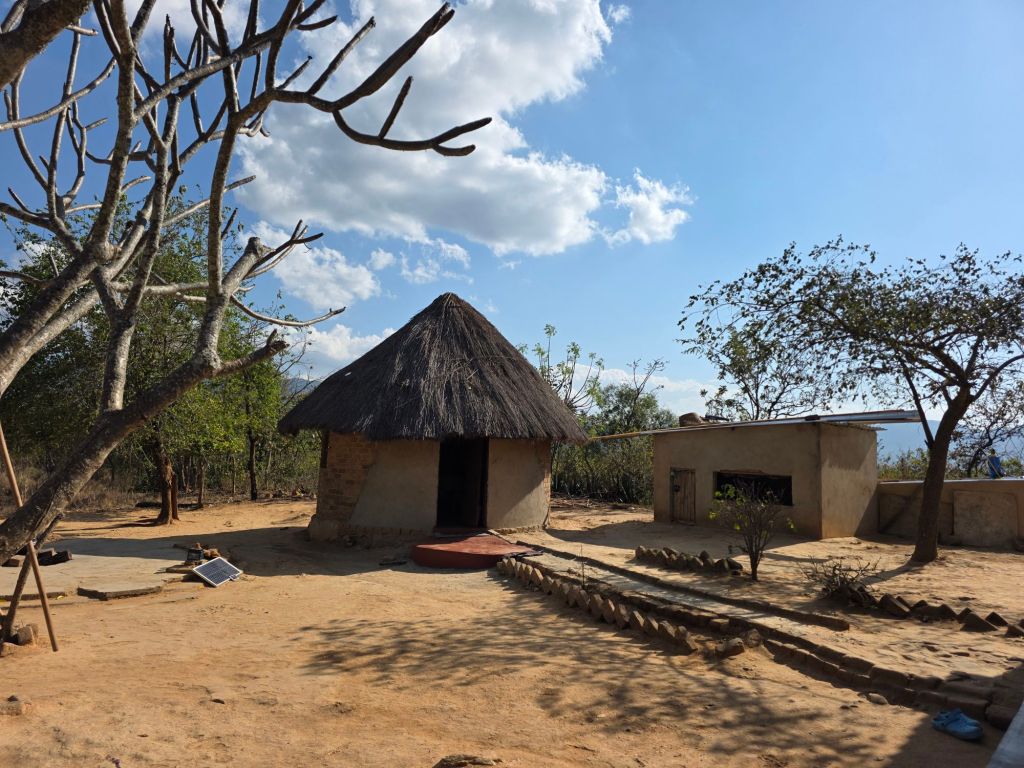
A note on the round huts in Zimbabwe: the tradition is that the wife of the household gets her very own round hut, which is used for cooking (by her) and for important family gatherings and business. During a family meeting, the family sits in a circle in the round hut. The men sit on benches built into the walls, and the women sit on the floor (unless they’re cooking). (Zimbabwe, you will be unsurprised to hear, is a patriarchal society by tradition, although that is slowly beginning to change.)

The interesting thing about the round huts is that, if the marriage is polygamous (which it sometimes is), each wife gets a round hut built by her husband, AND they don’t share with the other wives. Even after death, the round hut is not reused by anyone other than her children. New wife, new round hut. This round hut was Mona Lisa’s mother’s.

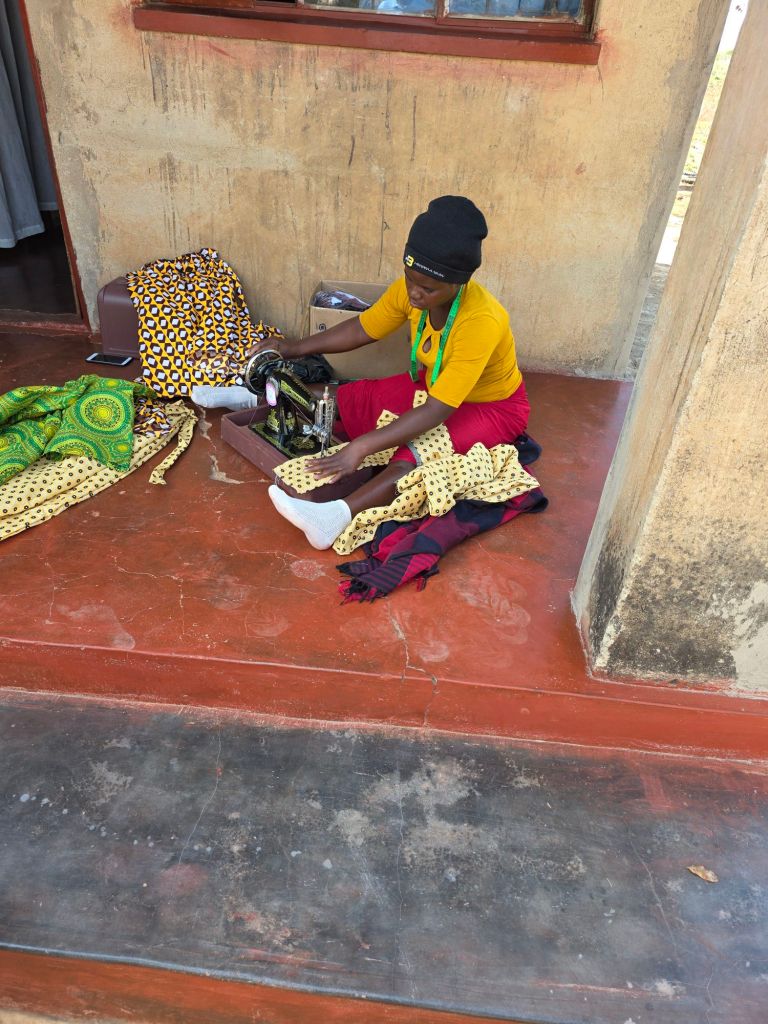
When Mona Lisa’s sister returned, she became part of the household again, but now Mona Lisa is the boss. She taught her sister tailoring, and her sister now makes the clothes that Mona Lisa used to make. Also, her siblings feed the chickens, so everybody has a responsibility. The cooking is shared between the two sisters, and Mona Lisa has a duty roster.

Here is Mona Lisa’s sister making clothes on the porch of the “square house”:
And, finally, here is Mona Lisa’s round hut, taken as we left. The square house is to the right, out of the frame. The low structure to the right is a chicken coop, for her broilers.
And that’s enough for one blog post. (I had an unusually long break this afternoon, so was able to catch up.)