We’ve been in Zimbabwe for a couple of days now, and, unsurprisingly, it’s been a whirlwind.
After a 7 am Sept 9 Chapel Hill — 4:30 pm Sept 10 Harare (which is six hours ahead of Chapel Hill, so equivalent to 10:30 am) = 24 + 3.5 = 27.5-hour trip, we arrived at the front entrance of the Robert Mugabe International Airport, where we met Barbara Matsanga and her senior social worker, Dennis, for three more hours of travel to Mutare, Zimbabwe’s third largest city. Mutare is to the far east of Zimbabwe, about 8 kilometers from the border with Mozambique, in a mountainous region.
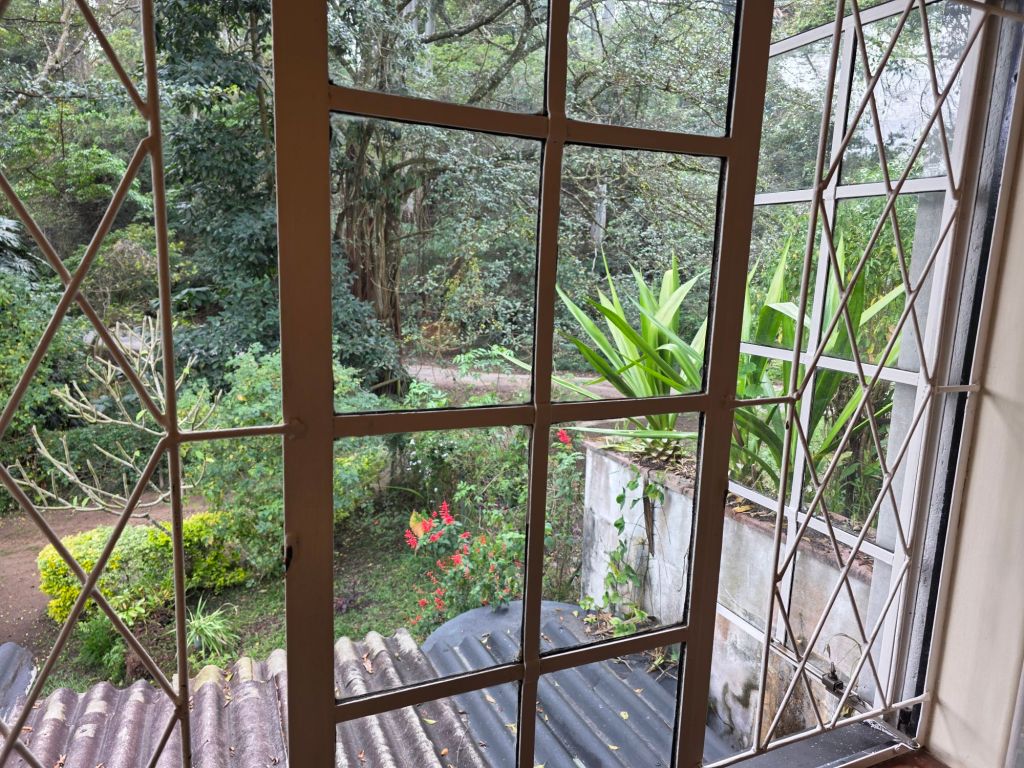
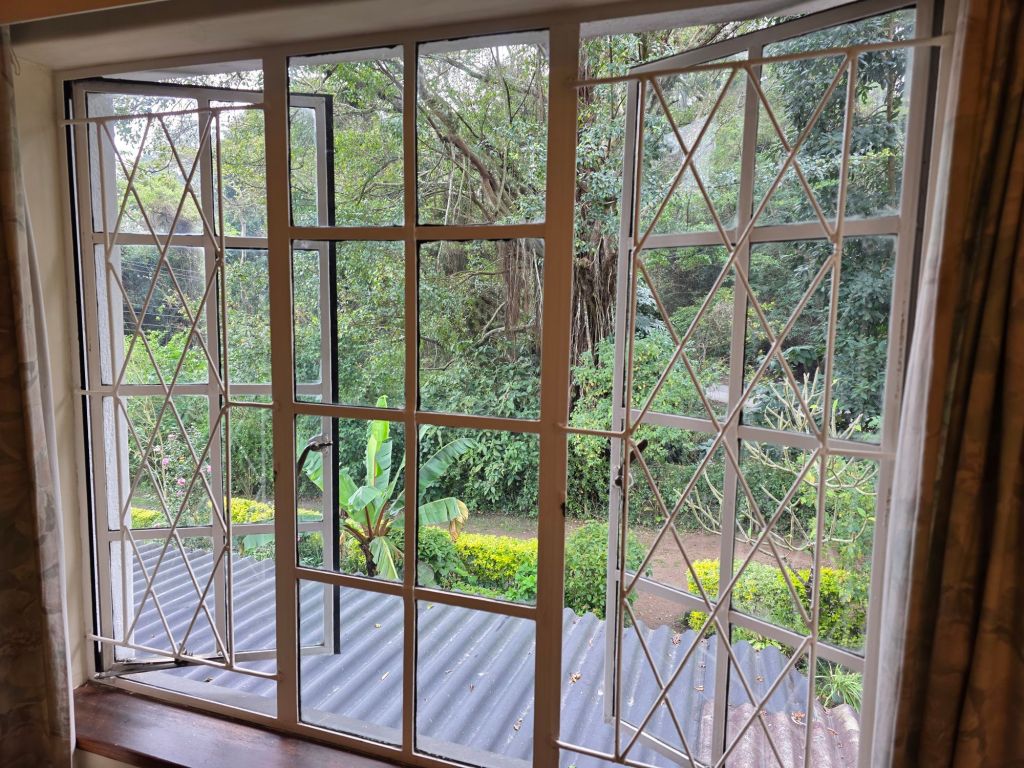
We are staying in the White Horse Inn, which feels like it was built when Zimbabwe was known as Rhodesia (I don’t know if it actually was). It’s a beautiful place nestled lush in forest, just off a curvy mountain road.
This is the view out of our room in the morning:
The first day, we met with some government officials:
- Secretary for Provincial Affairs and Devolution
- District Development Coordinator for Mutare & Mutasa
This was a little bit different from our experience in other countries.
Then we went to the Zoe offices in Mutare for another brief and overview.
Mona Lisa
After that, on to meet our first Zoe orphan, Mona Lisa, at her home. She actually graduated from the program a year ago. She is 24, and lives with her sister, aged 25, and two younger siblings [significant correction: at first I had written that they were her children], which I think are 7 and 12 (I didn’t take good notes because my brain was still mush).
Her sister actually got married and moved out, but there was some trouble, and she wound up moving back. She told us her story.
Before she enrolled in the Zoe program, she lived with four other siblings. Her strongest memory was that the blanket they all slept under was not enough to keep them warm in the winter. (Temperatures go down to the high 40s in winter here.) They ate one meal per day. She was unable to afford a uniform for school, or food for lunch, or even shoes, so she showed up every day essentially inadequately prepared for school. She was looked down upon and constantly got sent home because she didn’t have the uniform, plus her siblings were starving. So, she decided to drop out of school.
Once a child drops out of school, it is a particular challenge for them to go back, because it takes them years, and then they find themselves in a class with 9-year-old, and it’s just difficult to resume.
After she enrolled in Zoe, she learned how to plant a household garden for nutrition. Part of her initial grant of $150 allowed her to buy a sewing machine. On her own initiative, she joined the tailoring training offered to another Zoe group.
She also used money she earned from table banking to buy water piping for her household garden, to make it more productive.
Table banking is an informal system of banking formed among the members of the working group, in which records are kept and money is loaned and repaid with interest. (The community at large also has table banking.) This enables Zoe kids to both borrow money for investments like improvements to their small businesses, and to earn money from interest.
She raises chickens for meat, to sell. (That was probably an early income stream.)
She also observed another woman, a member of the larger community, making woven handbags, and asked that woman to teach her to do that, which she did.
At this point, she has several income streams from these activities, which she was able to start after training from Zoe. From these income streams, she was able to send her younger siblings back to school. Education is particularly important to Zimbabweans, although sending the younger siblings back to school is a common pattern among all the Zoe orphans I’ve met.
(A note on Zoe training: some of it is offered by Zoe staff themselves, but a lot of it is contracted by Zoe with local sources. For example, a master builder or the equivalent of a local agricultural extension agent. Our money goes to things like this, in addition to paying the Zoe staff themselves, and micro-grants to the kids. I’ll have to get the ratio of Zoe staff to kids, but it’s high, something like ten working groups for each staff member (each working group will have approximately 100 total children, so that works out to a ratio of 1:1000+.)
Anyway, here’s Mona Lisa and Dennis, along with Michelle, another member of our group. (Sorry, Michelle, I don’t have better a picture of you. :) ) This is in Mona Lisa’s round hut, and these are handbags she weaves.
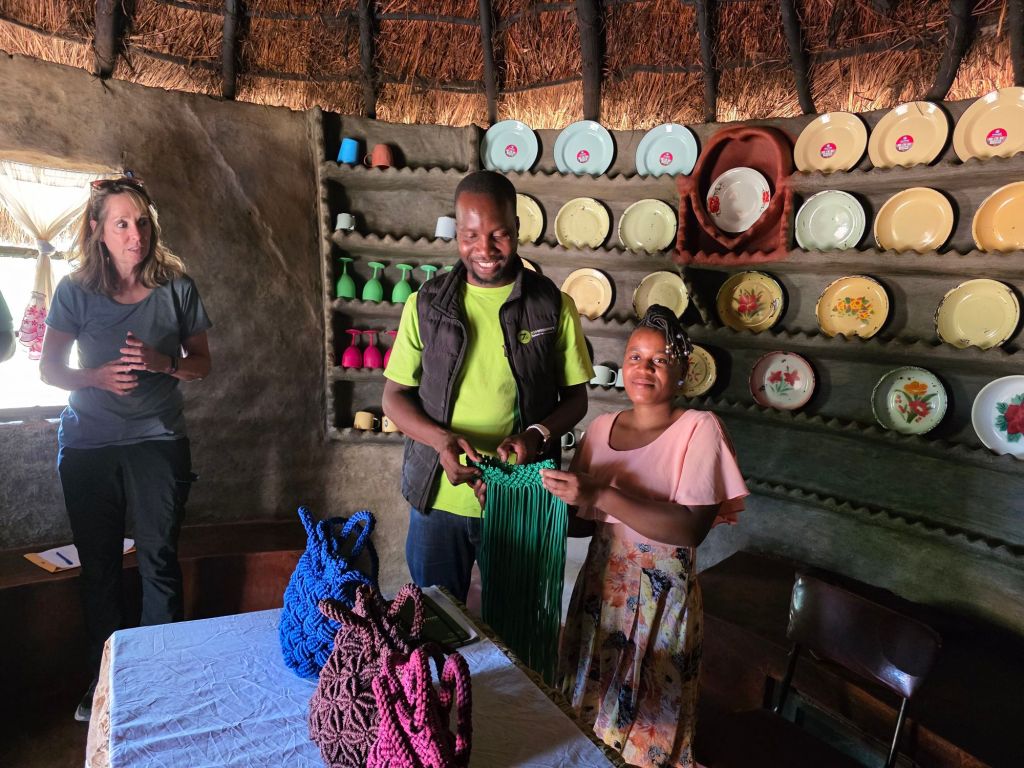
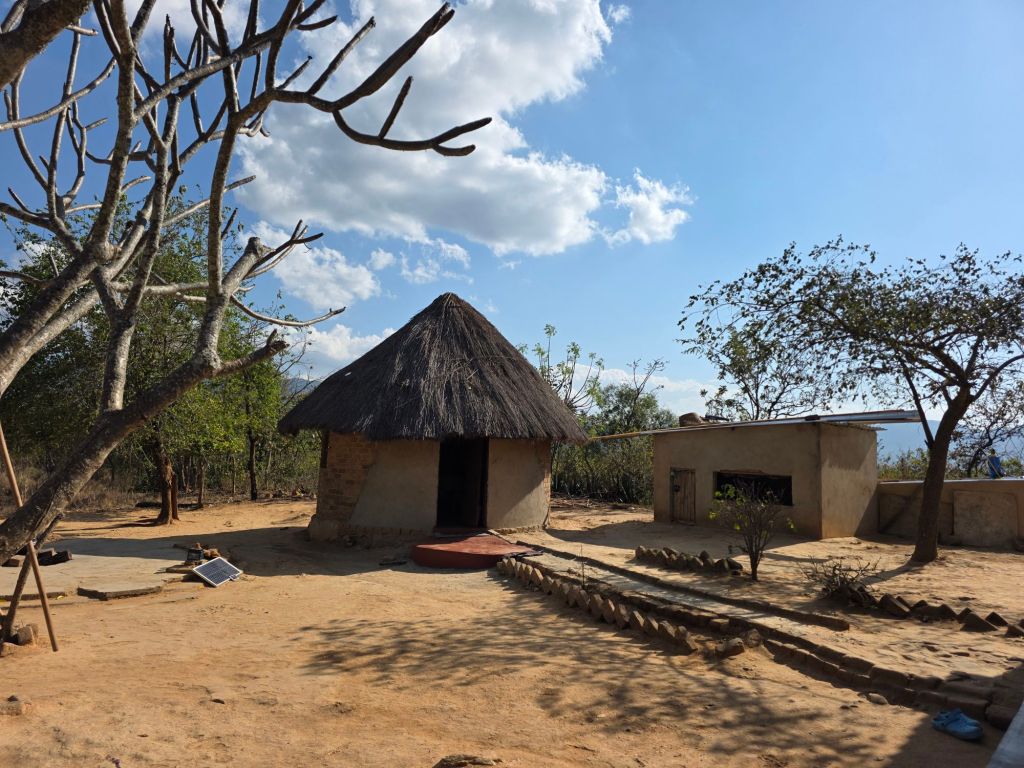
A note on the round huts in Zimbabwe: the tradition is that the wife of the household gets her very own round hut, which is used for cooking (by her) and for important family gatherings and business. During a family meeting, the family sits in a circle in the round hut. The men sit on benches built into the walls, and the women sit on the floor (unless they’re cooking). (Zimbabwe, you will be unsurprised to hear, is a patriarchal society by tradition, although that is slowly beginning to change.)
The interesting thing about the round huts is that, if the marriage is polygamous (which it sometimes is), each wife gets a round hut built by her husband, AND they don’t share with the other wives. Even after death, the round hut is not reused by anyone other than her children. New wife, new round hut. This round hut was Mona Lisa’s mother’s.
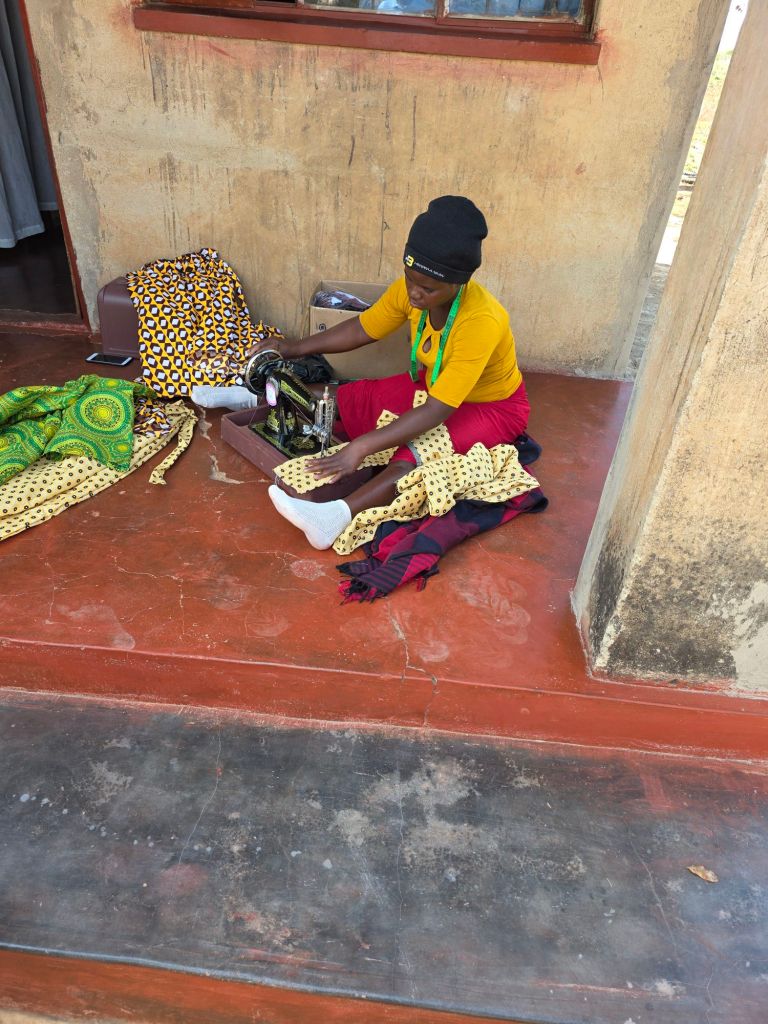
When Mona Lisa’s sister returned, she became part of the household again, but now Mona Lisa is the boss. She taught her sister tailoring, and her sister now makes the clothes that Mona Lisa used to make. Also, her siblings feed the chickens, so everybody has a responsibility. The cooking is shared between the two sisters, and Mona Lisa has a duty roster.
Here is Mona Lisa’s sister making clothes on the porch of the “square house”:
And, finally, here is Mona Lisa’s round hut, taken as we left. The square house is to the right, out of the frame. The low structure to the right is a chicken coop, for her broilers.
And that’s enough for one blog post. (I had an unusually long break this afternoon, so was able to catch up.)


Thanks John for the update and sharing these individual stories!
LikeLike
University UMC is holding you all close as you share stories and learn together.
LikeLike